Showing posts with label Hungary. Show all posts

Monday, March 17, 2014

A St. Patrick’s Day miracle for the Irish/Hungarian genealogy blogger

You may be thinking, “It’s a miracle! Finally a new blog article from Lisa!”

Though this very well might be a small miracle, there is a real miracle I’d like to share with you in honor of St. Patrick’s Day. It is a documented phenomenon that occurred over three centuries ago that is still remembered and celebrated today. It is close to my heart for a very special reason, as you’ll see when you read on.

I first posted this article three years ago, but really wanted to share it again this year. Happy St. Patrick’s Day from Smallest Leaf!


As a Catholic and a mother, I often look to Christ’s mother, Mary, for inspiration. She is the perfect example of womanhood. Her life has provided encouragement to women for many generations, including my own and my beloved ancestors’ (on both the Irish and Hungarian/Croatian sides of the family).

In many places throughout the world, Mary is remembered by a special name or title, or honored with a particular statue or painting containing her image. There are countless “names” for Mary. I thought I had heard of most of them.

I was surprised to come across a new title for Mary recently that I absolutely could not believe. As the descendant of Irish and Hungarian ancestors, I was thrilled to discover the Irish Madonna of Hungary. The story behind this title of Mary involves a beautiful painting, two European cities a continent apart, and a documented miracle that is as surprising as it is inspiring.


The village of Clonfert in County Galway, Ireland could not hide from the troubles facing the island during the middle of the 17th century. Oliver Cromwell was imposing his will on the Irish people – often brutally – and many, particularly church leaders, were displaced, persecuted, or killed. Among those was one Irish bishop by the name of Walter Lynch. As history tells us, Bishop Lynch was forced to flee his native Clonfert to Galway city. After the attack and capture of Galway, he was pursued to the island of Inisbofin, and then escaped to mainland Europe. He was in Austria by 1655 – four years after fleeing Clonfert. While in Austria, the good Bishop met the Bishop of Győr, Hungary, who offered him the opportunity to continue his ministry within the Győr diocese until the time when Bishop Lynch could safely return to his homeland.

Sadly, Bishop Lynch, who was making plans to return to Ireland, passed away in Győr in the year 1663, twelve years after leaving Clonfert. During his travels as an exile, the Bishop had carried with him a painting of Mary and the child Jesus (shown below), which he had saved from the Clonfert cathedral. Before his passing, Bishop Lynch had placed the picture in the care of the Bishop of Győr, who put it on display in the Győr cathedral.


Thirty-four years passed with the painting housed in the Győr cathedral. The Hungarian faithful venerated this beautiful image of the Madonna, and felt sure that Mary’s intercession on their behalf had ensured their recent victories over the Turks. By the year 1697, Hungary was enjoying newfound peace. Unfortunately, that same year, Ireland was beginning to face one of its greatest trials: the outlawing of the Catholic faith, the confiscation of its churches, and the banishment of all Catholic clergy from the British Isles.

As historical accounts tell us, on the feast of St. Patrick on March 17, 1697 a miracle occurred in Győr. According to the account of a priest who witnessed the event, “…the picture of the Blessed Virgin in the cathedral began to weep copiously.” Additional details recorded indicate that this “weeping”, or “bloody sweat”, went on for several hours, and that witnesses of various denominations were unable to attribute the occurrence to any natural cause. Eventually, word of the miracle spread throughout the city. It was witnessed by thousands, many of whom signed a document indicating their presence at the time of the miracle. These included the imperial governor of the city, mayor, councilmen, the Bishop, priests, Protestant ministers, a Jewish rabbi and many more. A linen cloth used to soak up the liquid is still on display today in the cathedral. The inscription on the case reads: “This is the true cloth which was used to dry the blood, which this picture shed in this church on St. Patrick’s Day 1697.”

The linen cloth on display in Győr Basilica today
(Image thanks to Győri Egyházmegye - Győr Diocese)

The beautiful image of the Irish Madonna of Hungary, also referred to as the Consolatrix Afflictorum (Consoler of the Afflicted), remains in the cathedral to this day, framed in silver above the altar. For over three centuries, it has played a special role in drawing together the two nations of Hungary and Ireland.


Every March 17 since 1947 (the 250 year anniversary of the miracle), even during the Communist regime, Hungarian priests have made a pilgrimage to the Győr cathedral and visited the Győri Könnyező Szűzanya (Győr Weeping Virgin Mary) or Ír Madonna (Irish Madonna), as they call the painting in the Hungarian language.

Hungarian priests in procession at Győr Basilica
(Image thanks to Győri Egyházmegye - Győr Diocese)

Other special celebrations occur regularly for Hungarian lay Catholics to honor Mary’s weeping image in Győr, and there is even an annual Croatian-speaking celebration. Irish Catholics, too, regularly make pilgrimages to the Irish Madonna of Hungary. The year 1997 (the 300-year anniversary of the miracle) saw a special exchange as the Irish Clonfert Bishop John Kirby was presented a copy of the painting by Győr Bishop Lajos Papai on his visit to the city.

Győr, Hungary's Bishop Lajos Papai giving a copy of the
painting to Clonfert, Ireland's Bishop John Kirby
(Image thanks to Hitvallás)
As Clonfert’s Bishop John Kirby wrote, “The kindness shown to Bishop Walter Lynch has led to an unusual link between the small Irish rural diocese of Clonfert and the large Hungarian diocese of Győr centered in a big industrial city. It has shown us the value of friendship and the way that the consideration shown to a refugee can deepen the understanding between peoples who might otherwise never have known each other. The history of the painting has an even deeper message. It reminds us of the faith and trust in the intercession of Our Lady that existed both in Ireland and in Hungary 350 years ago.”

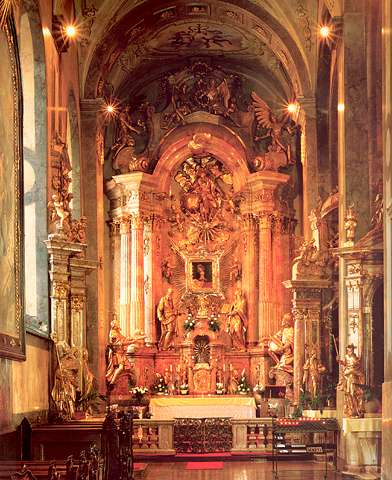
The Basilica of Győr today
Where were my Irish and Hungarian ancestors 350 years ago? I haven’t determined that yet, but it is interesting to imagine the possibilities knowing the history of the time.

As you may know, Catholics like to choose patron saints for themselves. I think it’s pretty obvious that Mary, the Irish Madonna of Hungary, is the ideal patron saint for this Irish/Hungarian genealogist! I hope that Győr’s Weeping Virgin Mary, the Consoler of the Afflicted, will smile down on my efforts to continue the search for ancestors on both sides of my family tree: those from Bishop Lynch’s beloved native Ireland, and those from Hungary, the country that welcomed him with open arms.


If you'd like to read more about the history of the Irish Madonna of Hungary, check out the following websites and books:
Note: This article is cross-posted to one of my Irish genealogy blogs, Small-leaved Shamrock.  Happy St. Patrick's Day to all!

Tuesday, December 10, 2013

My Catholic, Hungarian and Croatian Genealogy QuickGuides™ now available as Kindle eBooks


If you are tracing Catholic, Hungarian or Croatian roots (or two of those, or all three!), you may be familiar with my Catholic, Hungarian and Croatian Genealogy QuickGuides™. Published in partnership with Legacy Family Tree, these resources were first available as PDF downloads on the Legacy Family Tree website.

I am pleased to announce that all three guides are now available as Amazon Kindle eBooks. Whether you have a Kindle (or use the free Kindle app on your computer, tablet or smartphone) you can now have handy access to these guides in eBook format.

What's the difference? The PDF downloads are in a compressed format and make the guide compact for easier printing and sliding into the rings of a notebook. The eBooks include the same content laid out into book format, so they have more pages. They would use up more paper if printed, yet are easily scrollable using a Kindle or Kindle app.

For more details about each individual guide, visit:

Happy researching!

Monday, December 9, 2013

My new Hungarian Genealogy QuickGuide™: Trace your roots in the land of the Magyars

Hungary’s legacy as a nation extends back a millennium, and its people (and diaspora) are proud of their great heritage, myself included. As a child I was intrigued by the idea that my own grandfather had been born in a different country a world away. I grew up with the tastes and smells of Hungarian Gulyás (goulash), Töltött káposzta (stuffed cabbage), Csirke paprikás (chicken paprika), and Kifli from my grandmother's kitchen. It was only natural to me to want to learn more about this country that figured so largely in the lives of my grandparents and to want to delve into my Hungarian family tree.

My Hungarian Genealogy QuickGuide™
is a resource for both experienced researchers
and those new to tracing their Hungarian roots
After the recent success of my Croatian Genealogy and Catholic Genealogy QuickGuides™, I decided to focus on sharing the resources and research tips I've found while tracing my Hungarian roots. In partnership with Legacy Family Tree, I am pleased to present a brand new aid in your search for roots in the land of the Magyars: my Hungarian Genealogy QuickGuide™, a downloadable resource that includes -
  • An overview of the history and geography of Hungary (as a nation and as part of the Austro-Hungarian Empire)
  • Details about the types and whereabouts of available civil and church records
  • A description of the various types of archives and repositories that house Hungarian records
  • An introduction to the languages in which Hungarian records were written
  • Links to many types of online resources (genealogy guides, translation tools, maps, forums, blogs and more)
  • A list of genealogy-related publications in both English and Hungarian
  • A research strategy to follow for success in tracing your Hungarian roots

The search for roots within the age-old kingdom of Hungary, though often made complex by various languages and border changes, can be a greatly rewarding experience. Hungary has long been a crossroads, and Hungarian ancestors’ histories and records of genealogical interest are intertwined with neighboring countries and the empires and occupiers that ruled the area over the centuries.

If you have ancestors who emigrated from Hungary and would like to begin to trace or continue to deepen your knowledge of your family tree, I hope you'll allow me to share what I've learned with you.

~

Update: I am pleased to announce that all three of my genealogy guides are now available as Amazon Kindle eBooks. Whether you have a Kindle (or use the free Kindle app on your computer, tablet or smartphone) you can now have handy access to these guides in eBook format.

What's the difference? The PDF downloads are in a compressed format and make the guide compact for easier printing and sliding into the rings of a notebook. The eBooks include the same content laid out into book format, so they have more pages. They would use up more paper if printed, yet are easily scrollable using a Kindle or Kindle app.

For more details about the other QuickGuides™ I've authored, see: My new Catholic Genealogy QuickGuide™: Let me help you find those Catholic ancestors and My new Croatian Genealogy QuickGuide™: Journey with me back to your roots in Croatia.

Happy researching!

Thursday, December 5, 2013

Hungarian Kifli at Christmas: A long legacy of motherly love

I've shared our family's Kifli recipe several times already here at 100 Years in America, telling the story of how I finally learned the Hungarian name of this traditional favorite. (By the time I came along my family was calling them "Gramma's Christmas Cakes". This European treat had Americanized its name along with the names of my immigrant ancestors!)

This year I'd like to share this delicious family treasure again within my series of Advent Calendar of Christmas Memories articles, giving a little more attention to our family's special legacy with regard to this delicious traditional favorite.


This is the first Christmas that our family will celebrate without a very special family member, my dear Aunt Barbara. She passed away last January. It has been almost a year now, yet the passing of the first Christmas without a loved one is probably one of the most difficult milestones when grieving a loss. So it is with dear Barbara, for myself and the rest of the family, but particularly for her children and grandchildren, I'm sure.

One of 100 Years in America's most faithful readers, one of Barbara's daughters, faithfully bakes these family Christmas cakes each year (and provided me with the beautiful photograph above). One of the sad moments she experienced this month was not being able to call her Mom and say, "Guess what I'm making?" My cousin was taught by her mother, Barbara, who was taught by her mother, our dear grandmother Mitzi. A young bride at age 18, Mitzi had gone to live with her new husband in the household of his mother (and many siblings) several states away from her home. There she was trained to cook and bake as her mother-in-law did, using her recipes from northeastern Hungary. One of the recipes Mitzi mastered: Hungarian Kifli.

Mitzi's mother-in-law, Maria (Németh) Tóth (known as Mary in America), was a 34-year-old mother of four when she emigrated from Hungary's Borsod county to join her husband. Along with transporting four children (one a baby!) on that journey, Maria carried with her a wealth of Hungarian family recipes that would be treasured by many generations of our family over the next century (and hopefully more!).

I like to imagine Maria as a young girl within her mother's kitchen, learning to cook the Hungarian Gulyás (goulash), Töltött káposzta (stuffed cabbage), Csirke paprikás (chicken paprika), and Kifli that would become our family's favorites. Maria and her mother could not possibly have imagined that a century later and a world away, their descendants would remember them and their recipes fondly, having received the legacy of nourishing love produced by the hands of their daughters, daughters-in-law, and grand-daughters.

As I once again share this Kifli recipe, I do so in honor of these women who came before us: my dear Aunt Barbara, my grandmother Mitzi, my great-grandmother Mary (Maria), and her mother (another Barbara): Borbála* (Nagy) Németh.

*Borbála is the Hungarian version of the name Barbara


100 Years in America's Family Kifli Recipe

Otherwise known as "Gramma's Christmas Cakes"


Apricot Jelly Filling

3 lbs. apricots
1 1/2 cups sugar
Cinnamon

  • Put them in a pot with enough water to cover them plus about 1 inch more
  • Cook for about 45 minutes until soft, stirring frequently
  • Mash the apricots
  • Add sugar
  • Cook about 1 1/2 to 2 hours until very thick (the longer the better), stirring frequently
  • Sprinkle the jelly with cinnamon


Christmas Cakes

4 cups flour
1/2 lb. sweet butter at room temperature
6 eggs - separated - at room temperature
1 teaspoon salt
1 teaspoon vanilla
8 oz. sour cream at room temperature
4 tablespoons sugar
1 packet of yeast (prepared by mixing with 1 teaspoon sugar & about 1/4 cup milk)
Homemade apricot jelly
1 lb. walnuts (add 4 teaspoons sugar to each lb. when chopped)
Confectioner's sugar

  • Mix flour with butter and then salt and sugar
  • Make a well in the middle - add egg yolks, vanilla and sour cream gradually
  • Mix and kneed until smooth (keep working the dough until ready)
  • Use flour to make it not too sticky (can freeze - wrap in freezer paper and cover with flour)
  • Roll out dough
  • Cut the dough into 4 pieces
  • Chop walnuts and whip egg whites
  • Roll out one of the 4 pieces of dough
  • Cut into individual 3 1/2 x 3 1/2 squares and fill with a heaping teaspoon of homemade apricot jelly
  • Roll each into a horn (crescent)
  • Top each with egg whites and nuts
  • Bake in the oven at 350 degrees until light brown (about 30-35 minutes)


Kifli may also be served with a prune filling (prepared similarly to the apricot filling) or a walnut filling, although the apricot kind has always been the favorite in my family. If using walnut filling, add boiled milk to the nuts until pasty, then grated lemon rind.


~


This article is part of a series written in celebration of the Advent and Christmas seasons. It will be included as part of the Advent Calendar of Christmas Memories 2013, Day 4: Christmas Recipes. For more Advent and Christmas memories here at 100 Years in America (going back to 2007), scroll through these articles or stop by my Pinterest page. Visit this preview for more details about the GeneaBloggers Advent Calendar of Christmas Memories and to get some inspiration to get yourself in the holiday spirit!

Note: Our family's Kifli recipe has also appeared previously as part of the Advent Calendar of Christmas Memories here at 100 Years in America several times (once in 2007 and then twice in 2009 - here and here). Over the past six years, these have continued to be among the most frequently viewed articles here at 100 Years in America. If you took the time to try out our family Kifli recipe, please leave a comment and let us know!

Saturday, November 17, 2012

The patron saint of my Hungarian family tree: St. Elisabeth of Hungary


A holy card printed in 1907 for the 700th anniversary 
of the birth of St. Elisabeth of Hungary. 
(Thanks to my daughter who gave me this treasure after finding 
it in a village flea market during her recent trip to Italy.)


St. Elisabeth of Hungary (Szent Erzsébet in Hungarian; Heilige Elisabeth in German) lived a short life (only to the age of 24), but she made such an impact that she was canonized by the Catholic Church only four years after her death. She was born over 800 years ago, but we know much about her family tree back to her great-great-grandparents' generation, and her incredible personal legacy of faith continues to this day. Today, November 17, is her feast day.

Born in the year 1207, at a very young age Elisabeth, daughter of King András II of Hungary, was betrothed to Ludwig IV of Thuringia and taken to live within the Thuringian court. The two became close childhood friends and enjoyed a short and happy marriage until Ludwig died of the plague, leaving Elisabeth a widow at the age of twenty with several young children.

A statue of St. Elisabeth holding roses in
Rózsák tere (Roses Square), Budapest, Hungary
Stories of her generosity to the poor and the miracles that accompanied her work are plentiful. She is best known for the legendary "miracle of the roses".  According to Holy Rulers and Blessed Princesses: Dynastic Cults in Medieval Central Europe by Gábor Klaniczay (published in English in 2002), the story "in which a disapproving father attempts to expose Elisabeth, who is secretly stealing alms for the poor in her apron, and finds her pious lie turn the contents of her apron into roses" first appears in written form at the end of the 13th century. Elisabeth is commonly depicted holding these miraculous roses. This is the reason (along with the fact that she was a princess) that many little girls (including my own) have chosen to dress as St. Elisabeth of Hungary on All Saints Day!

I was thrilled to see that much detail is known about Elisabeth's royal family tree. Here's hoping that someday I can find a family connection to her ancestral line.

Wikipedia has links to a number of articles about many of Elizabeth's
ancestors, including her grandfather King Béla III, one of the richest
and most powerful monarchs in European history.
Elisabeth's Hungarian heritage and the fact that my name derives from Elisabeth endear her to me, yet there is another reason that I've chosen her as patron saint of my continued efforts to uncover the roots of my Hungarian family tree. Like my great-grandmother Helen Ulaky, St. Elisabeth was a lay Franciscan associated with the Third Order of St. Francis of Assisi. In fact, just before his death in 1226 St. Francis, aware of her assistance to the poor thanks to Franciscan friars in Thuringia, sent a personal message of blessing to St. Elisabeth.

The Third Order of St. Francis had its start in 1221. Elisabeth's death in 1231 made her the first Third Order Franciscan to be canonized a saint. On her canonization she was declared the patron saint of the Third Order of St. Francis, a role she shares with St. Louis IX of France.

~

The beautiful holy card pictured at the beginning of this article was printed in 1907 in celebration of Elisabeth's 700th birthday. The year 2007 (the 800th anniversary of her birth) also saw a renewed focus on the history of and devotion to St. Elisabeth of Hungary with celebrations throughout Hungary, Germany, Austria and also worldwide through the Third Order of St. Francis. The town of Marburg, Germany was a special focus of the year since it was the place of Elisabeth's death and its Elisabethkirche was the location of her shrine and relics until 1539. The church was a place of pilgrimage for many Europeans during the medieval period. Today her relics are located in various churches throughout Austria, Germany and France.


One side of the German 10 Euro coin minted in
celebration of the 800th birthday of St. Elisabeth

Tuesday, July 31, 2012

H is for Hamburg and the Hopes of Emigrants

Little Pista Tóth (Pista means "little Stephen" in Hungarian) was just shy of 2 1/2 years of age when he, his siblings, and his mother boarded the S.S. Pennsylvania in Hamburg, Germany on May 4, 1907. The family had left their home in northeastern Hungary to make a new life in America, where their father had already spent some time. István Tóth had been in Trenton, New Jersey during 1902 and 1903 and then returned to his wife Mária (Németh) Tóth and his two young daughters, Mária and Ilonka. István's young son and namesake, had arrived in 1904. István had then returned to America and awaited the arrival of his family, including the final child born into the family in Hungary: baby Lajos. (You can read more of this family's story here.)

This list of passengers departing Hamburg on May 4, 1907 lists Maria Tóth
of Gelej, Hungary with her children Maria, Ilonka, Pista and baby Lajos.
Father Istvan awaited them in Trenton, New Jersey. (Click to enlarge)

It is quite a picture to imagine this young family from the little village of Gelej, Hungary staying at the Auswandererhallen (Emigrants’ Halls) in Hamburg, Germany awaiting their ocean voyage to America.

Image of Hamburg's Emigrants' Halls thanks to
Ballinstadt Emigration Museum.
The BallinStadt, otherwise known as the Emigrants' City, was a multiple-building facility designed so that passengers arriving by rail from Eastern European countries could be directed straight to the port and avoid passage through the city of Hamburg. According to the Ballinstadt Emigration Museum website, "In the year 1907 alone, a total of nearly 190,000 emigrants departed from Hamburg into an uncertain future. Hamburg had become Germany’s number one emigration port."

The young Tóth family arrived at Ellis Island in New York via the S.S. Pennsylvania of the Hamburg-Amerika line fifteen days after departure from Hamburg. What a trip it must have been for a wiggly 2-year-old little boy, his older sisters, his baby brother, and his poor mother!

The Tóth family arrived in New York on the S.S. Pennsylvania on May 19, 1907. 

Thanks to the Ellis Island Immigration Museum in New York City and the Ballinstadt Emigration Museum in Hamburg, I can visit museums at both little Pista Tóth's port of arrival in America and his port of departure in Germany. What an amazing chance to get a personal glimpse into what this little boy might have experienced just over 100 years ago on his trip to a new world with his family.

Image of the S.S. Pennsylvania of the Hamburg-Amerika Line 
from the Gjenvick-Gjønvik Archives: The Future of our Past.

Note: The Staatsarchiv Hamburg has digitized passenger lists for those departing from the port during the years 1850-1934. These Hamburg passenger lists and their handwritten indexes are available through Ancestry.com.


This article was originally published here at 100 Years in America in 2008 as "A little boy, a big ship, and a brand new world". I've reposted it as part of the Family History Through the Alphabet Challenge.  Follow me here at 100 Years in America as I try to keep up with the challenge to work through the alphabet while writing my family history.

Friday, November 18, 2011

On the hunt for roots in Hungary: The basics of Hungarian genealogy

If you have roots in Hungary, your research will center around the records of the Roman Catholic Church - no matter the faith of your ancestors.  That's one of the basic facts of Hungarian genealogy that I've shared in my latest article over at The Catholic Gene.

King St. Stephen presiding over Buda Castle, Budapest
It was over 1,000 years ago that the Hungarian state was founded under the leadership of Stephen I, later to be canonized and remembered as King St. Stephen.  Today as the Hungarian parliament has reaffirmed the nation's ties to its Catholic foundation with the creation of a new constitution, the faith of the Hungarian people continues into the 21st century. Anyone doing Hungarian genealogy will come face to face with the Catholic legacy of this nation. For more on this topic - including an overview of Hungarian research, tips and resources for the search, and examples from my own family tree - stop over to my article entitled Hungarian Genealogy: It All Goes Back to the Catholic Church.

Thursday, March 17, 2011

A St. Patrick’s Day miracle for the Irish/Hungarian genealogy blogger

You may be thinking, “It’s a miracle! Finally a new blog article from Lisa!”

Though this very well might be a small miracle, there is a real miracle I’d like to share with you in honor of St. Patrick’s Day. It is a documented phenomenon that occurred over three centuries ago that is still remembered and celebrated today. It is close to my heart for a very special reason, as you’ll see when you read on.

Happy St. Patrick’s Day from Smallest Leaf!


As a Catholic and a mother, I often look to Christ’s mother, Mary, for inspiration. She is the perfect example of womanhood. Her life has provided encouragement to women for many generations, including my own and my beloved ancestors’ (on both the Irish and Hungarian/Croatian sides of the family).

In many places throughout the world, Mary is remembered by a special name or title, or honored with a particular statue or painting containing her image. There are countless “names” for Mary. I thought I had heard of most of them.

I was surprised to come across a new title for Mary recently that I absolutely could not believe. As the descendant of Irish and Hungarian ancestors, I was thrilled to discover the Irish Madonna of Hungary. The story behind this title of Mary involves a beautiful painting, two European cities a continent apart, and a documented miracle that is as surprising as it is inspiring.


The village of Clonfert in County Galway, Ireland could not hide from the troubles facing the island during the middle of the 17th century. Oliver Cromwell was imposing his will on the Irish people – often brutally – and many, particularly church leaders, were displaced, persecuted, or killed. Among those was one Irish bishop by the name of Walter Lynch. As history tells us, Bishop Lynch was forced to flee his native Clonfert to Galway city. After the attack and capture of Galway, he was pursued to the island of Inisbofin, and then escaped to mainland Europe. He was in Austria by 1655 – four years after fleeing Clonfert. While in Austria, the good Bishop met the Bishop of Győr, Hungary, who offered him the opportunity to continue his ministry within the Győr diocese until the time when Bishop Lynch could safely return to his homeland.

Sadly, Bishop Lynch, who was making plans to return to Ireland, passed away in Győr in the year 1663, twelve years after leaving Clonfert. During his travels as an exile, the Bishop had carried with him a painting of Mary and the child Jesus (shown below), which he had saved from the Clonfert cathedral. Before his passing, Bishop Lynch had placed the picture in the care of the Bishop of Győr, who put it on display in the Győr cathedral.


Thirty-four years passed with the painting housed in the Győr cathedral. The Hungarian faithful venerated this beautiful image of the Madonna, and felt sure that Mary’s intercession on their behalf had ensured their recent victories over the Turks. By the year 1697, Hungary was enjoying newfound peace. Unfortunately, that same year, Ireland was beginning to face one of its greatest trials: the outlawing of the Catholic faith, the confiscation of its churches, and the banishment of all Catholic clergy from the British Isles.

As historical accounts tell us, on the feast of St. Patrick on March 17, 1697 a miracle occurred in Győr. According to the account of a priest who witnessed the event, “…the picture of the Blessed Virgin in the cathedral began to weep copiously.” Additional details recorded indicate that this “weeping”, or “bloody sweat”, went on for several hours, and that witnesses of various denominations were unable to attribute the occurrence to any natural cause. Eventually, word of the miracle spread throughout the city. It was witnessed by thousands, many of whom signed a document indicating their presence at the time of the miracle. These included the imperial governor of the city, mayor, councilmen, the Bishop, priests, Protestant ministers, a Jewish rabbi and many more. A linen cloth used to soak up the liquid is still on display today in the cathedral. The inscription on the case reads: “This is the true cloth which was used to dry the blood, which this picture shed in this church on St. Patrick’s Day 1697.”

The linen cloth on display in Győr Basilica today
(Image thanks to Győri Egyházmegye - Győr Diocese)

The beautiful image of the Irish Madonna of Hungary, also referred to as the Consolatrix Afflictorum (Consoler of the Afflicted), remains in the cathedral to this day, framed in silver above the altar. For over three centuries, it has played a special role in drawing together the two nations of Hungary and Ireland.


Every March 17 since 1947 (the 250 year anniversary of the miracle), even during the Communist regime, Hungarian priests have made a pilgrimage to the Győr cathedral and visited the Győri Könnyező Szűzanya (Győr Weeping Virgin Mary) or Ír Madonna (Irish Madonna), as they call the painting in the Hungarian language.

Hungarian priests in procession at Győr Basilica
(Image thanks to Győri Egyházmegye - Győr Diocese)

Other special celebrations occur regularly for Hungarian lay Catholics to honor Mary’s weeping image in Győr, and there is even an annual Croatian-speaking celebration. Irish Catholics, too, regularly make pilgrimages to the Irish Madonna of Hungary. The year 1997 (the 300-year anniversary of the miracle) saw a special exchange as the Irish Clonfert Bishop John Kirby was presented a copy of the painting by Győr Bishop Lajos Papai on his visit to the city.

Győr, Hungary's Bishop Lajos Papai giving a copy of the
painting to Clonfert, Ireland's Bishop John Kirby
(Image thanks to Hitvallás)
As Clonfert’s Bishop John Kirby wrote, “The kindness shown to Bishop Walter Lynch has led to an unusual link between the small Irish rural diocese of Clonfert and the large Hungarian diocese of Győr centered in a big industrial city. It has shown us the value of friendship and the way that the consideration shown to a refugee can deepen the understanding between peoples who might otherwise never have known each other. The history of the painting has an even deeper message. It reminds us of the faith and trust in the intercession of Our Lady that existed both in Ireland and in Hungary 350 years ago.”

The Basilica of Győr today
Where were my Irish and Hungarian ancestors 350 years ago? I haven’t determined that yet, but it is interesting to imagine the possibilities knowing the history of the time.

As you may know, Catholics like to choose patron saints for themselves. I think it’s pretty obvious that Mary, the Irish Madonna of Hungary, is the ideal patron saint for this Irish/Hungarian genealogist! I hope that Győr’s Weeping Virgin Mary, the Consoler of the Afflicted, will smile down on my efforts to continue the search for ancestors on both sides of my family tree: those from Bishop Lynch’s beloved native Ireland, and those from Hungary, the country that welcomed him with open arms.


If you'd like to read more about the history of the Irish Madonna of Hungary, check out the following websites and books:
Note: This article is cross-posted to one of my Irish genealogy blogs, Small-leaved Shamrock.  Happy St. Patrick's Day to all!

Monday, March 8, 2010

On babies and transatlantic crossings

It was just a few short years ago that my husband and I took a very memorable trip to Europe. We traveled accompanied by our children, including the newest addition to the family: our baby daughter just shy of five months old.

The trip was challenging in many ways. Long plane flights, long walks, luggage-toting, frequent adjustments to new sleeping arrangements in hotels and guest houses...

The trip was not for the faint-hearted. Each child was tasked with toting their own suitcase and/or carrying a backpack, etc. I carried my baby almost continuously for two straight weeks. Time strapped into her car seat was very limited (only a couple of taxi rides and one rental car trip required it). We traveled almost exclusively by train through France, Switzerland and Germany, baby in my arms. We didn't even consider taking a stroller. It was hard enough to get on and off the Paris metro with a baby and her siblings not to mention a bulky stroller!

Our littlest one loved the trip. She constantly had new things to look at. It was the dream vacation for a baby who has not yet had the inclination to crawl.

Some friends with similar-aged children thought we were crazy to attempt such an adventure. One, whose baby was the same age as ours, said, "I can barely make it to the grocery store. How did you make that trip to Europe?"

During some of the more difficult moments of our trip, when things seemed momentarily overwhelming for this traveling mother and her young family, I found inspiration in the memory of my great-grandmother's journey from Europe with her toddler to meet her husband in America, who had left several years before. Ilona (Bence) Ujlaki, known to me as Grammy Ulaky, had faced her trip alone with her young son. His illness and his resultant stay at Ellis Island had to be a trial extraordinaire for a young mother, only age 24. Surely, if she could make it through that ordeal, I could make it through my journey. I pressed on knowing that my struggles were not half as difficult as hers.

Now, several years later, I have additional inspiration in the perseverance of motherhood: my great-grandmother Maria (Németh) Tóth. Like Ilona, Maria had crossed the Atlantic alone on her way to join her husband in a new country. She, however, had three young children with her - plus a baby!

You may have read the post about my discovery of baby Lajos' name on the U.S.S. Pennsylvania passenger list originating in Hamburg and then again on the list at Ellis Island. I was amazed to find the name of a family member who I had never heard existed. After further contemplation, I am even more amazed at the fact that this poor mother, my great-grandmother, survived such a trip with her young children and baby and made it to America with her sanity intact.

Imagine this: one adult with four young children ages six, four, two and five months. No disposable diapers. Not even a toilet, for goodness sake. No bag full of extra cookies, snacks and juice boxes. Probably not even decent meals or clean water, if enough water was even available. Fifteen straight days in the steerage section of a ship after a cross-continent trip by train from Hungary to Germany.

Ughhhh.

Don't forget to consider the fact that along the way Maria faced difficulty in communicating with fellow passengers, train and ship employees, and workers at the ports of Hamburg and Ellis Island. I wonder how many Hungarian speakers she actually encountered along the way. It must have been a relief to speak with someone in her native tongue.

I know from traveling with young children that no trip is easy. But what I know about the journey of my great-grandmother Maria (Németh) Tóth is almost unthinkable to me as a mother. In pondering the struggles that she must have faced on her journey to America, I can only hope that somehow she received special grace from God during her trial and met a few kind and helpful strangers on her way.

I never had a chance to meet my great-grandmother, known to her family as Grammy Toth. If I could do so today I would thank her as a great-granddaughter and a fellow mother: with thanksgiving for her perseverance during what was possibly one of the greatest trials of her life. Her courage and sacrifice made it possible for our family to begin a new life in America.

This article was originally published on March 10, 2008.  It has been reposted here in honor of women's history month.

Friday, February 12, 2010

Hungary Exchange: A new stop on the web for Hungarian genealogists

A new resource for Hungarian genealogy has set up shop on the web this week.  The Hungary Exchange website, put together by Nick Gombash, hopes to become a stopping point for many a researcher in search of Hungarian roots.  Nick created this new online resource in hopes of helping Hungarian genealogists to make new connections to further their research. He writes that the "main objective of the new website will be the sharing and exchanging of records and documents". Among its amenities are a surname database where genealogists can submit names and corresponding locales of research, and an online discussion forum and message board for those researching Hungary and countries formerly part of the Austro-Hungarian Empire.

The Hungary Exchange website includes the following webpages:
The Hungarian Marriage Project, Databases and Surname Database pages are works in progress that are off to a good start and will become useful to more researchers as Nick adds data over time.  As Nick states on his blog, "The most important of these databases, a major project that I have undertaken, is the Hungarian Marriage Project. My plan is indexing the marriage records from pre-WWI and including them in a database. I'm hoping to eventually have help down the line, as well. I already have records from four parishes, soon to be five and with an estimated total near 5,300 marriages."

My Hungarian surnames are listed within the surname database - add yours today!  As Nick states in his announcement of Hungary Exchange on his genealogy blog, "Let's knock down all those brick-walls and find family!"

The Hungary Exchange website’s Links page includes both national and regional Hungarian resources helpful to genealogical research. It lists web addresses for archives (national archives and at least one for each county), maps and gazetteers, online databases, a Hungarian family tree website, genealogy societies, research aids/guides, translation services, and Jewish resources.

Nick Gombash was recently the subject of an edition of Gini Webb's "May I Introduce You to..." series on Thomas MacEntee's GeneaBloggers blog.  To learn more about Nick visit the article, stop by his blog, or visit his Gombash and Rodgers Family Website.

Don't forget to stop by Hungary Exchange Forum and also take a few minutes to send your Hungarian research locales and surnames to Nick for the Surname Database at Hungary Exchange.

This article has been posted as part of the Follow Friday series.  Visit Thomas MacEntee's GeneaBloggers for more suggestions for good online reading.

Wednesday, February 10, 2010

To the guardians of 100 Years in America: Happy 105th Anniversary!

They were married one-hundred-and-five years ago this week, on the day after Valentine's Day: February 15, 1905.  Regular readers will recognize the couple whose photo graces the banner of this blog. They are truly the stars of 100 Years in America.  Residing here online, their photograph welcomes you, the readers, and watches over the many family stories, photographs and genealogical details that I have shared.


I have written much about this couple: my great-grandparents Ilona (Bence) and Ferencz Ujlaki. They were both born in the Međimurje region of Hungary, which is now Croatia.  Along with many other Hungarian citizens of their generation, they left Europe in search of a new life in America.  The stories of their journeys to the new country are the stuff of legends, yet those experiences were just a part of life for them.  Their childhoods in an ethnic Croatian village in Hungary and their beginnings in America as foreign immigrants formed them, and have become part of the fabric of our family, inspiring those of us who have come after them.

It is sometimes easy to forget that our ancestors were once young men and women with their lives ahead of them, sorting out who they would be and dreaming big dreams for their lives.  This photograph puts my great-grandparent's lives in perspective for me in that way.  I am told that it was taken shortly after they were married, and it is the closest thing our family has to a wedding photograph of the young 20-year-old bride Ilona and her new husband, 25-year-old Ferencz.

I was thrilled to be able to view microfilmed copies of the civil marriage registry from the town of Legrad where my great-grandparents were married.  Legrad is located today within northern Croatian on the Hungarian border.  At the time of Ferencz and Ilona's wedding, the village was part of Zala County, Hungary, so the civil records were written in the Hungarian language.


Ferencz and Ilona were both born and raised in this area - Ferencz in Donja Dubrava (formerly known as Alsó-Domború) and Legrad; Ilona in Legrad.  They began their life together as a married couple one-hundred-and-five years ago in Legrad's village church.  The Holy Trinity Catholic Church of Legrad (Župa Presvetog Trojstva), a beautiful late-Baroque one-nave parish church, was built around 1780.

A postcard of Legrad's Holy Trinity Catholic Church, c. early 20th-century

Legrad's Holy Trinity Catholic Church today
(Photo courtesy Filip Lucin)

You can see a small portion of the civil marriage registry listing the names of the bride and groom below.  See the top right on the image for Ujlaki Ferencz and Benczey Ilona (the Hungarian spelling of the bride's maiden name). Below the bride's maiden name is her married name Ujlaki Ferenczne. This means Mrs. Ferencz Ujlaki. (It is the name under which she is listed on the S. S. Carmania's ship manifest - and the reason that I had difficulty finding her listed at first.) On the marriage registry, also notice the seal of Legrad in the bottom right corner and the Hungarian crests in the background.


More than likely it was a cold winter day in Legrad when Ferencz and Ilona were married 105 years ago.  They were married for 34 years until his untimely death at age sixty.

A happy 105th wedding anniversary to my great-grandparents this Valentine's Day!  May the memories of their lives and marriage live on in the hearts of their descendants for another century.


This article has been submitted to the Valentine edition of footnoteMaven's Smile for the Camera carnival.  Visit her Shades of the Departed blog for more "valentine" photographs.

Sources:

Photograph of Legrad's Holy Trinity Catholic Church today courtesy of Filip Lucin.  Special thanks to Filip for the permission to use this great photograph and others in his collection.  Visit his Croatian language blog for more.

Map of Croatia thanks to www.legrad.blog.hr.

Hungary. Zala County. Legrad, Házasultak 1895-1906 from series Állami anyakönyvek, 1895-1919 (Civil registration - births, marriages, deaths - for Légrád, Zala, Hungary). Anyakönyvi Hivatal, Légrád, Zala County, Hungary, Ferencz Ujlaki-Ilona Benczey; FHL VAULT INTL Film 1791809 Item 1. 

Thursday, January 21, 2010

"Crossing": A poetic remembrance, 1909

Crossing
A poetic remembrance, 1909 
by Lisa


A young, new mother and her little son.
A village farm. A loving family.
A husband in a distant unknown land.
Her task: to leave and cross the massive sea.

Sad looks and words and tears from family.
Her mother’s broken heart in deepest prayer.
A bag or two, her child, and they must go.
A world to cross before arrival there.

Across the continent by train to shore,
the port looms large and daunting, and right then
a thought suddenly shakes her halting heart:
she’ll never see her home country again.

With husband waiting on the other side,
she and her young son step off of the land
and onto this new vessel of the sea –
but their place is below, so they descend.


In steerage – tossing, shifting, dark and damp –
below the deck they wait and count the days.
In such close quarters her young son takes ill.
She nurses him and counts the hours and prays.

The days pass slowly, painfully – eighteen –
of engine noise and air too stale to breathe.
And fever! Purgatory on the sea!
Her hope is for the day that they may leave.

Amidst her pain and suffering she finds
more travelers in similar despair.
Some countrymen whose ways and words she knows,
but many foreign tongues are from elsewhere.

She finds herself within a strange new world
and wonders where this voyage will yet lead.
Her strength and faith are rising, falling, while
the ship is tossed and pitched out on the sea.

How glorious – the day she hears the news
that land is near; departure eminent.
But joy is short-lived as this mother learns
the place where her ill baby will be sent.

In pain with measles, he must be confined.
Son and his mother forced to separate.
Her salty tears form oceans near her feet.
All she can do is pray and hope and wait.


Then finally the flood of trials departs
when mother, son – and father! – meet once more.
The sea of separation which they faced
is now behind them as they step ashore.

A young, new mother and her little son.
Her husband by her side in a new land.
This family steps into a new life
holding each other tightly by the hand.

© Lisa / Smallest Leaf Press


Written in memory of the transatlantic journey of twenty-four-year-old Ilona (Bence) Ujlaki and her two-year-old son Ferencz. They traveled by train from Legrad, Hungary to the port of Fiume, Hungary (now Rijeka, Croatia). Their third class (steerage) voyage on the S.S. Carmania to New York harbor lasted for eighteen days: from February 13 to March 2, 1909. While on board the ship, little Ferencz became ill with measles.  After the ship docked at Ellis Island, he was separated from his mother and hospitalized. After being reunited, Ilona and her son were able to meet their husband and father, the elder Ferencz, and begin their new life in New York City. Ilona, later to be known as Helen Ulaky, was my great-grandmother.

This poem has been submitted to the 89th edition of Jasia's Carnival of Genealogy whose topic is Ode to My Family's History featuring family history-focused poems. (Thanks to footnoteMaven for this edition's poster shown here).

Want to read more of my poetry?  Check out my parody of Katharine Lee Bates' America, The Beautiful: 100 Years in America the Beautiful, my limericks honoring my Irish immigrant ancestor entitled A poem for Patrick, or the little ditty I wrote to describe myself as an Irish family history blogger: A limerick for the love of Ireland.

For more from Lisa, visit Smallestleaf.com.

Related Posts with Thumbnails